Monday, June 1, 2015

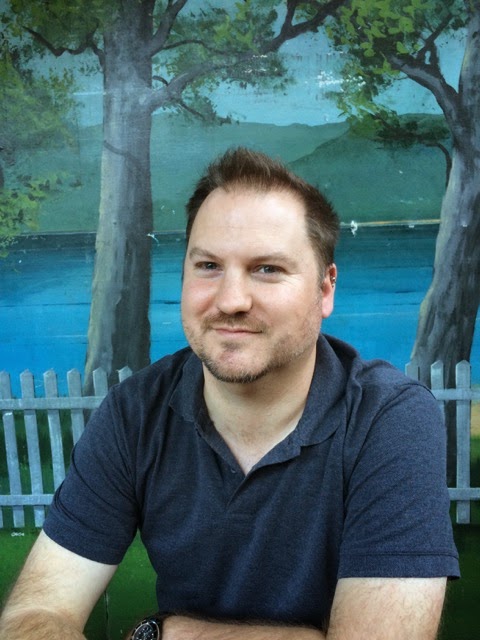
CRUX #6 - STUART BARNES

I've not met Rockhampton's Stuart Barnes (only communicated with him via emails and twitter). I'd very much like to. I think we'd have a good chat about poetry (surprise, surprise), layers to Australian masculinity and the evolution of pop and dance music both in Australia and abroad (topics we love). 

Stuart's highly engaging and refreshing poetic voice has both a beat sensibility and an academic feel - there's a looseness, or restlessness, as well as a great sense of purpose. The stuff of his work is snatched from pop culture, history, family, place... you name it. That's not to say it isn't original. Stuart's educational and entertaining poems get me researching, taking notes, telling myself I need to take more risks in my own writing.


Queensland's bloody lucky to have him! 


Stuart is a Tasmanian-born poet and poetry editor of Tincture Journal. In 2014 his manuscript Blacking Out and other poems was named runner up in the Arts Queensland Thomas Shapcott Poetry Prize. His first collection, Bend River Mountain, an anthology with Robbie Coburn, Nathan Hondros, Rose Hunter, Carly-Jay Metcalfe and Michele Seminara, will be published by Regime Books in 2015. He blogs at stuartabarnes.wordpress.com and tweets as @StuartABarnes.


1. What was there before poetry?

The consciousness of and fascination with poetry has always existed; the reading of and the tinkering with since childhood; the detailed re/arranging of for seven years.

2. Share with me a story or memory from your formative years.

Winter, a glass-door wood heater, my grand/parents and me, recliners, books.

3. How do friends and family help shape your writing?

From the beginning, and without knowing, my parents have helped shape my writing: my mother gave me picture books in my bassinet (the only distraction the rustling leaves of a nearby almond tree, apparently), a vinyl book at bath time and, when I was a little older, the How and Why Wonder Books, the Bible, a dictionary, an encyclopaedia; both read to me at bedtime. I’m not the first to say it: the key is reading, reading, reading. I’m grateful my parents insisted on it.
            As I’ve mentioned elsewhere, Gwen Harwood was an inspiration, instrumental in my becoming a poet. At middle and high school I was fortunate to know a small group of passionate young men whose interests included architecture, film and music; one also wrote: he and I came equal second in what I think was our school’s inaugural short story competition. I was outraged: his was about catching rainbow trout, mine a man dying of AIDS. I still have that story, which borrowed heavily from The Cure’s ‘Pictures of You’ and Auden’s ‘Funeral Blues’. Maybe that’s the origin of my interest in found poetry … My high school Literature teacher Amanda Jackson and English teacher Liz McQuilkin, also a poet, were very encouraging, as was Deborah Rechter, my first year Literature tutor at Monash University. That kind of support was/is wonderful, but it’s vital to nourish it. For many years I couldn’t/didn’t.
            Friends and family continue to help by reading and commenting on drafts and manuscripts, by connecting me with other poets (a couple of months ago a family friend’s brother put me in touch with Welsh poet Ric Hool, who generously provided invaluable feedback about a manuscript). Most recently they’ve been helping by inspiring: I’ve been working on poems about moments from childhood, poems written to the memory of my maternal grandmother, my favourite uncle, three friends. It has taken some time to be able to write about these much-loved people.
            Many years ago, to members of my extended family, uncles and male cousins mostly, writing was ‘a waste of time’, ‘a joke’, I a ‘freak’, ‘weirdo’, ‘faggot’, ‘big girl’, ‘wuss’. I wasn’t impervious to their bullying; I’ve always been determined; their aggression made me even more, I think. For a time I wrote for and with a strong sense of having to prove something to others.

4. What’s the most difficult thing about writing a poem?

Learning to let go of expectation, which aids determining one’s method: for some time I was heavily influenced by part of Ted Hughes’ introduction to Sylvia Plath’s Collected Poems: ‘To my knowledge, she never scrapped any of her poetic efforts. With one or two exceptions, she brought every piece she worked on to some final form acceptable to her … Her attitude to her verse was artisan-like: if she couldn’t get a table out of the material, she was quite happy to get a chair, or even a toy.’ I first read this at 30 and placed on myself enormous pressures. Exhausting, yet necessary. 
            Once you’ve determined your method, which is always evolving, learning to accept when a poem’s not working. Learning to put it away—for a day, several, a week, half a year, seven. And learning—gasp—when to let a poem go, which might one day lead to a conversation about learning to let everything—it’s all illusory—go.
            Finally, learning there are no rules.
           
5. How do people react to you being a poet? 

Melbourne’s worlds away; there I was a very different person, a very different poet, so I’ll talk about my experience of Rockhampton, famous for its cattle farmers, FIFO workers and bewildered tourists. I love living in Rockhampton—the freedom, the proximity to the sea, the glorious, golden 4 p.m. light—but it is a bit of a crucible. The farmers I’ve met have been nothing but blunt: ‘All day all you do’s twiddle your thumbs, chew the end of a pen’: zero tolerance. The FIFO workers have been baffled (‘You make how little money, mate?’) yet respectful (‘Least you’re doing something you love.’). The tourists, most from Europe, have been pretty interested. A drawn-out ‘Oh’, often followed by ‘That won’t pay the bills’, is the most common response from some of the people who work in the local supermarket. The chap who runs the nearby post office is probably my biggest fan: ‘Are you a famous poet yet?’ every time I go in. ‘No, just here to mail a book to a famous poet.’ ‘Roses are red, violets are blue’ was never funny or clever.

6. You have a great love for British band The Cure. Share with me your favourite Cure lyric and explain its power.

I’ve admired The Cure since 1992: ‘Friday I’m In Love’ shimmied from a speaker during American Top 40 one Sunday evening (these days I can’t listen to the track, which swamped every restaurant, café and club à la ‘Glory Box’ and ‘Groove Is In The Heart’). ABC’s rage introduced the band to me in 1990; I vividly remember the ‘Never Enough’ promo: I was intrigued and spooked by Robert Smith’s bizarre and beautiful harmonies, his swooping guitar-like vocals, his alter ego’s black eye shadow and black lipstick (within a few years I was occasionally armouring myself with both). In mid-’92 I travelled to and through Russia with a bunch of Australian scouts, venturers, rovers and leaders; I bonded with T, a huge fan of The Cure who faithfully toted every album to date on cassette. By the time I arrived in Hobart a little over a month later I was smitten, bitten, hooked, cooked, stuck like glue …
            It’s not my favourite lyric (that might be ‘Fires outside in the sky / Look as perfect as cats’, for its absurdity; or ‘So I trick myself / Like everybody else’, a bit of a bowling ball in the stomach; or ‘Oh I miss the kiss of treachery / The shameless kiss of vanity’, for its guilelessness about desire and long-term monogamous relationships) but ‘I went away alone with nothing left but faith’ (‘Faith’, Faith) is the most persistent, the most insistent, and powerful for two reasons: it flays religion and embraces the spiritual. It closes an exquisite record: heavily layered synthesizers, atmospheric six-string basses, songs perfectly sequenced. Faith was written in church, where Robert Smith would ‘think about death … look at the people … [who] wanted “eternity”. … [He] realised [he] had no faith at all and [he] was scared. … [He] wanted to get at different expressions of faith, to understand why people have it, to see if it was a real thing’ (Ten Imaginary Years). As writing Faith spurred Smith to think about his lack of faith, so listening to this particular lyric spurred me to think about mine.

7. What’s your greatest writing accomplishment?

It’s not that I won’t—I can’t, I’m not hardwired to think of my accomplishments in terms of greatness. Three that come to mind have been incredibly encouraging: my first published poem; shortlisted twice for the Newcastle Poetry Prize; my manuscript Blacking Out and other poems named runner up in the 2014 Arts Queensland Thomas Shapcott Poetry Prize.

8. If you had an hour with one Australian poet - living or dead - who would it be?

Dorothy Porter: I would love to talk about Akhenaten.

9. Where will the future take you?


My first poetry collection, Bend River Mountain, an anthology with Robbie Coburn, Nathan Hondros, Rose Hunter, Carly-Jay Metcalfe and Michele Seminara, will be published by Regime Books in 2015. I’m taking my time with another project. I’m looking forward to this year’s Queensland Poetry Festival. Really, I’ll be happy if I can continue to do what I love: write, edit, read.

Sunday, March 22, 2015

CRUX #5 - BENJAMIN DODDS


The work of Benjamin Dodds never pulls punches. If late firebrand and painter Adam Cullen had been a poet, he may well have been Benjamin Dodds. Both artists love throwing the filth and beauty of life in our faces. When reading Benjamin's poetry we feel wonderment and edginess in equal measure. Everywhere the reader looks there is dark humour, poignancy and stark imagery. Benjamin is often interested in unravelling the many contradictions within Australian men, something I find fascinating. And of course, there is a search for the divine, or at least something than can lift us from the mundane. Like his contemporaries Sam Wagan Watson and Aidan Coleman, Ben is fiercely economic with his language - this is why I love his work. Many verbose poets could learn from his editorial skill.

Benjamin resides in Sydney, where he teaches primary school students. He grew up in the NSW Riverina. His work has appeared in many publications including The Best Australian Poems 2014, Mascara Literary Review, Bluepepper, Harvest, Cordite, Blue Dog, Southerly and Antipodes: Poetic Responses and Earthly Matters, a chapbook poet Carol Jenkins assembled for National Science Week in 2010. His first full-length collection, Regulator, is out now with Puncher & Wattmann. 


                                                                              *

What was there before poetry?

Nothing. Poetry was there in the movement of the first motes of matter and we’ve been tracing its path ever since we learned to make our mark on cave walls, paper and now in digital zeroes and ones.

Would you ever return to the NSW Riverina to live?

An entire universe of childhood and adolescence is back there somewhere between the yellow lawns and weedy irrigation canals. My immediate family left the Riverina at the same time I moved to Sydney to study. I travel back every few Christmases with my parents to visit relatives, but I don’t think I’ll ever live there again. It feels too much like the past for me to plan any futures there. I must miss it on some level, though. I saw a photo of a Murrumbidgee River beach recently on Instagram and experienced a surprisingly intense longing to be there again and to dive in.

Tell me about your work with the NSW Department of Agriculture years ago.

It was my first job straight out of high school. There’s an agricultural research station just outside Yanco and they were offering a traineeship as a laboratory technician. I met some amazing individuals and took part in some fascinating science over what became three years. The majority of my time there was spent in the rice section, but I also moved through the soy and entomology sections and eventually became a fruit fly officer. The work was a really interesting mix of white lab coat and test tube stuff and a great deal of sampling and harvesting on trial sites all around the Riverina. I got to be Igor on some days and Old MacDonald on others. One of the weirder memories of my lab assistant days is of being trained to count the microscopic hairs around a fruit fly’s anus to determine its species. It was a bizarre, but important job. The day I counted one too many hairs (or was it one too few?) resulted in an emergency road trip to the head office in Orange to confirm and declare an official outbreak of European fruit fly. Exciting times!

Why did you get into primary school teaching?

Well, I became a primary teacher by way of first becoming a secondary teacher. My two teaching areas are English and Italian. I taught in a high school setting for a while and didn’t really fall in love with the job. I travelled and worked outside education for a bit and only returned to it when I saw an advertisement for an Italian teaching position at a local primary school. After teaching Italian for a few years, I was lucky enough to be given the opportunity to work as a regular class teacher. I’ve since been reaccredited as a primary teacher and it’s fantastic. I think teaching is a particularly vital profession. Who else in society, aside from parents, can have such a positive and lasting effect on young minds?

Were there many challenges associated with penning/assembling Regulator?

Yes, there were quite a few. Not so much with its penning, but certainly with its assembling. Because some of the pieces had been around for so long, I was very close to them. I couldn’t really get a true sense of which ones played well with others. Not through a new reader’s eyes in any case. I tried different permutations with my partner, a close friend and then fellow poet Stuart Barnes. They were all very insightful, particularly my mate Stuart, who was essentially the unofficial editor of the whole collection. In the end, I went with a bit of my own judgment and a bit of theirs and divided the book into four sections: RegulatorHuman Awe,There’s No Putting Them Out and Perfectly Normal Sons. The first loosely gathers together the poems dealing with the Riverina, the second brings together (also loosely) the pieces dealing with science and nature, the third contains poems that I began to realise were a bit on the darkly paranoid side and the fourth section touches on sexuality.

What does it mean to be a poet in Australia today?

What a tough question. There are so many types of Australian poets and poetry. Sometimes it seems that the job of the Australian poet is to wilfully alienate, but then there are so many more instances of Australian poets perfectly capturing a moment, an idea, a feeling or an angle through clear, exquisite and enduring language. This is not uniquely Australian, of course, but our poets can really hook us in ways that are specifically adapted to our particular wavelength of experience. Our best poets know who we are, for better or worse, but aren’t limited by identity.

What do you want your audience to most take away from your poetry?

Another really tough question! I know that I hold myself to a very high standard when I write a poem. I guess this means I want the reader to experience the best of me, work I’ve sweated over. Ultimately, I hope they take from my poetry a sense of mood and encapsulation. Somebody once told me that one of my poems expressed something that they’d always felt, but never known how to put into words. I don’t think a poet could ask for a better review.

Where to from here?

I’m working on a new project at the moment. Mostly in my head, not yet on the page, but its various parts are starting to swirl together and coalesce into what I hope it can be. I find it really hard to find solid chunks of writing time lately. Not because I’m too busy, but because modern technology seems to sap my creative energy and swell to take up so much of my ‘spare’ time. Sometimes I curse the internet, Netflix, my iPad and the infinite amount of other distractions available to us today. Maybe that’s where to from here, weaning myself off distractions and using the freed up time to write more! I’ve got a week away planned for the next school break. Just myself and my writing away from it all.

Thursday, January 22, 2015

CRUX #4 - FELICITY PLUNKETT


I've met Felicity Plunkett once. It was in 2011, when I was attending an Extension 2 English day for HSC Students at Beverly Hills Girls High School in Sydney. Felicity was conducting a workshop for Yr 12 poets, including a girl I was teaching. On behalf of my student, I asked Felicity some questions on how best to approach aspects of the rigorous Extension 2 course. Felicity was generous with her time and her answers were insightful. I contacted Felicity not long after this and questioned her about avenues to explore as an emerging poet. She read some of my online work. Again, Felicity was supportive. She strikes me as a woman who is wise,  professional and utterly selfless. Australia's poets are most fortunate to have her as a mentor, role model and critic. 

Felicity has a PhD in Literature from the University of Sydney. She is poetry editor with University of Queensland Press. Her rich, wide-ranging and inventive debut poetry collection, Vanishing Point, won the Thomas Shapcott Prize. A later, engaging collection, Seastrands, was published as part of Vagabond Press' Rare Object Series. She was editor of Thirty Australian Poets. Felicity has worked with Red Room Company on many projects. Felicity currently lives in Sydney.
                                                                                                         
What was there before poetry?

This question feels a little like ‘What was there before light?’ and has been waiting, unanswered, like a chicken-and-egg conundrum, for me to respond to. I remember always gravitating towards poetry, but when I began to discover poets during high school, at first through studying Latin (Catullus, then Virgil) I knew that this was important. Poetry started taking up, delightfully, a lot of space in my head. 

What are you first - poet, critic or editor? 

I don’t know how successfully I can disentangle the strands, since, broadly, reading and writing go hand-in-hand for me. I love an evocation of this by American writer Kevin Brockmeier in an interview in The Georgia Review. He argues for stoking your life and your writing with ‘books you find beautiful, enriching, fascinating, meaningful, fathomless, enchanting, or unextinguishable.’ It’s an ordered process, he suggests: ‘You let your reading fill your life and you let your life fill your writing.’ 

Having said that, I think that being a poet is probably the foundation. 

Tell me about your work with Extension 1 & 2 HSC English Students in NSW.

During my years as an academic, I was appointed to the Exam Committee for HSC English Extension 1 in NSW and subsequently took over the loftily-titled role of Chief Examiner of Extension 1 and English Extension 2 from 2004-2009. 

This involved chairing the exam committee, working with wonderful, creative teachers to develop the Extension 1 exam paper, and spending time in the exam centres for both subjects, working with the Supervisor of Marking and markers. 

I believe that each course is exemplary, and especially that having the opportunity to create an independent Major Work in English – whether poetic, fictional, performance, film or critical – is a brilliant opportunity for students. Every year I witness – and these days have some involvement in enabling – lucid, unique work produced by the 2000+ students who take this course. In 2014 I was especially blown away by work I encountered that was well beyond some work I see from tertiary students, and, in the case of some of the poetry and fiction, as good as some professional work I read as an editor. I have great respect for these students, and the teachers who enable them. It’s an energy-testing course, but one that opens a lot of mind-windows. Something I look forward to greatly is the further unfolding of some of these students’ talent. 

Which of your many literary achievements are you most proud of? 

I’m not sure about pride, but probably the most transformative achievement was winning the Arts Queensland Thomas Shapcott Prize for Vanishing Point, which involved publication with University of Queensland Press. I feel honoured (and, yes, proud) to be part of the group of poets who have won this prize, including Nathan Shepherdson, Sarah Holland-Batt, David Stavanger and most recently, Krissy Kneen. 

Think of the average Aussie bloke in a hi-vis work shirt. How do you make poetry reach him?

Perhaps it helps to think beyond averages and the human cladding that signals our differences, to remember that poetry has the capacity to be, as Robert Frost puts it ‘a fresh look and a fresh listen’. Poetry can reach a person and venture everywhere. Or as Yevgeny Yevtushenko writes: ‘Poetry is like a bird, it ignores all frontiers’. Each can go anywhere, but I’m not sure that you can make poetry, or a bird, do this. 

If you were to have a coffee with one dead poet, who would it be and why? 

I love to cultivate this possibility. I’ve spent hours, sometimes over coffee, with poets and their words. Possibly the two I’ve spent the most hours with are Sylvia Plath and Paul Celan. Plath was a wonderful cook, too. A slice of her lemon meringue pie would be good. 

What does the future hold?

In poetry, at the end of this summer I will be sending my new manuscript to a publisher for consideration. As an editor, I am at work on a number of highly-anticipated books by other writers. As a critic and reviewer I have a fascinating pile of books to respond to. Before this, a few days near the sea with my children. These parts of my plan, are, of course, subject to larger forces, of which poetry is one, but not the only one. 

Monday, December 22, 2014

CRUX #3 - PETER LACH-NEWINSKY


When I first moved to the Southern Highlands of NSW in 2009, celebrated poet Jennifer Compton (who I'd met through the Broadway Poetry Prize 2004; she was a judge, I was a runner-up) suggested I look up Peter Lach-Newinsky, who was living in Bundanoon. Jennifer had lived in Wingello in the Southern Highlands and knew Peter. I followed Jennifer's advice - Peter and I hooked up for tea in the Primula Cafe, Bundanoon. Since then, Peter and I have been good friends. I've searched - without success - for Little Bitterns on his twenty acre property, tasted many types of his heritage apples, discussed all things poetry with him and laughed a lot. Peter has provided me with perspective when the slings and arrows of poetic success have battered me. Peter is many things: husband, father, grandfather, farmer, naturalist, activist, thinker, eccentric, comic, rebel. To be with Peter is to be with a man who is fully aware of the world around him, thrilled to be fully alive. 

Peter has published several chapbooks with Picaro Press. He has won the Vera Newsom Poetry Prize and the Melbourne Poets Union International Poetry Prize (2009 and 2010). His latest full-length collection, Cut a Long Story Short, was recently put out by Puncher & Wattman in Sydney. Peter's reading at the launch for Cut... was electric. 

Peter was born in Germany and came to Australia with his German mother and Russian father. 

------------

What was there before poetry?

Before poetry there was the poetry of the Void then the poetry of the Big Bang then a lot of noise/silence as the universe revved up. Then poetry again. 

Tell me about your earlier life in Germany.

Well Germany is great technology so they’ve got Autobahns everywhere that allow you to experience the pleasure of having a Mercedes sitting on your tail bumper at 180 ks and a semi-trailer right in front of you while the car radio comes on automatically to tell you where the 30k-long traffic jams are so that everyone can try and avoid them and thus create another traffic jam. Deep in German woods I still heard traffic noise from freeways. There’s postcard Germany and there’s depressing Germany, like everywhere else. The people are different and the same. They also had a radical youth and student movement in the 60s and 70s which I found was where the energy was, where it was at, at the time. I was in my 20s and 30s, so I was into energy. I kept reading English, writing English poems for myself, teaching English in English in order to keep the English neurons connecting inside a German head. They do great philosophy in Germany. They also invented Aldi. News broadsheets didn’t have personal stories or photos but only solid print: people tend to be more serious. Here, I sometimes miss that, although humour is essential in remaining sane.

Describe your writing process.

Um, lotsa ways. Maybe early morning pen on paper, maybe editing old poems on computer, maybe none of the above. Anything can trigger this weird activity. I have no set routine or methods, except I usually come inside when it’s too hot to work outside on the farm and sit at the computer and write away for a few hours at something or other (poems, essays, blogs).  I have books strewn all over the place which I’m using or intended to or intend to, dog-eared, marked, awaiting processing/quoting... Often I’m working on several things at once, or just drop them for long periods or never finish them. Sometimes I can’t stand reading poetry (like eating cake all the time), prefer prose, novels, non-fiction, science.

What has kept you in Bundanoon for so many years? 

The farm. The commitment to place and growing roots there. Maintaining the trees I have planted. Why would I go elsewhere? I no longer need to find paid work. I’ve had to move too much in my life. There’s a spiritual and ecological limit to modern nomadics. Moving, you just take your boring old self along again anyway. Although even just travelling can be nice, it is much overrated. Like most places, Bundanoon is a very special place. Suburbanisation, aka development, is the usual danger.

What troubles you? 

The survival of civilisation, humanity, great sections of our plant and animal cousins, a livable planet. The continuation of capitalism, imperialism, nationalism and mainstream majority obedience and voluntary slavery. The survival of books, solitude, concentrated reading and knowledge in the deep sense in a world of totalised screens, info overload and so-called social media.

What brings you great happiness? 

The farm and all its beings, trees, some animals, the ocean, books of all kinds, some music, some art, a few poems, some writing, most little kids but especially my two grandsons.

Which of your chapbooks are you most proud of? 

Chapbooks or books? Pride? Can’t say I favour one over the other. Has to be equality in a family, no favouritism. Each book a product of its time and state of mind. Out of my hands once published. Not mine anymore. Becomes a bit of the collective mind, well that is if there’s at least one reader.

Cut A Long Story Short - give me the big picture. 

This last book is subtitled  ‘ A myth in 80 poems and four seasons’. Maybe that’s the gist of ‘the big picture’. Kind of a structured ‘memoir’, also containing some poems I wrote in my 20s, 30s and 40s, so kind of a New & Selected in some ways. It attempts a reading of the personal/autobiographical (as poetic myth of course, not ‘truth’) against the public/political of the last 60 years, as I don’t think the two can really be separated. It also references a lot of other favourite poets because we all write ‘intertext’ whether we know it or not, standing on the shoulders of many others.

What will tomorrow bring? 

Rain, drought. Noise, silence. Life, death. The usual. The unexpected. Change. The illusion of time passing. 

Sunday, November 16, 2014

CRUX #2 - JOHN FOULCHER


How do I introduce John Foulcher? He is an icon, a luminary. So many Australians have devoured his work, hungered for more. My words here won't do him justice! 

I first read John's lyricism in the early 1990s. It made an indelible impression. I return to John's poems when I want to find serenity in my day. I also open his work up when my own writing seems rudderless, hollow, inadequate. John's writing is economic, crisp, honest, open to interpretation and deeply evocative. There is nothing sentimental or preachy there. When we digest a Foulcher poem, we immerse ourselves in so many wonderful things, find ourselves transported entirely. He understands the Australian people, he understands Australian landscape. 

John's poetry has been widely published and anthologised; he has published nine collections. From 1986 to 1994 several of his poems were set for study on the NSW HSC Syllabus. John has been granted four Australian Council Residencies, the most recent at the Keesing Studio in Paris during 2010-2011. He has a brand new poem in The Best Australian Poems 2014 through Black Inc. John has taught English to many students in Victoria, the ACT and NSW. 

                                                                                   *

Before writing poetry, what were you doing to make sense of the world?

That’s a difficult question. I wrote my first poem when I was about sixteen. Before that, the world didn’t make much sense at all; everything seemed like wind, and I had no control over anything. Poetry was like riding the wind – that sounds melodramatic but it was like that, initially. I suppose I looked to religion as well, or, more precisely, the story of Jesus. All that unendurable suffering at the heart of the story resonated with me, I think. I’ve always had a religious sense of life, though I’ve remained on the margins of conventional Christianity, occasionally falling off the edge. I’m not sure poetry has helped me make sense of the world – more exactly, it’s made the ambiguities of the world more bearable. Turn anything into art and it becomes more bearable.

What have you learnt about yourself and teenagers after many years teaching English in high schools?

I’ve learned we never really grow up, that the tempestuous concerns of teenagers are all our concerns. Familiarity, though, makes them easier to negotiate. I’ve learned that young people help you in seeing the world in fresh, invigorating terms. I’ve also learned that I never want to be eighteen again. Why would you go back there?

People are divided on their opinion of Canberra, where you now live. Why do you think that is?

When I first moved to Canberra from Sydney, many of my Sydney friends were, well, a little bewildered, I think. ‘Why would you want to do that?’ one asked me. ‘It’s the world’s largest lawn cemetery.’ I think there’s a kind of cultural cringe in that sort of response – ‘oh Canberra’s so boring’, that sort of thing, as if life only occurs in the freneticism of big cities. I hate the way people sneer at Canberra because it’s ‘sterile’. Interesting that many overseas visitors, many the ones without the agendas of youth, like Canberra. It’s a soft focus city, it has a calm. I think it also suffers from the conflation of government and place. I’m happy in a way, though, when people deride Canberra, and often agree with them – it keeps them away. Canberra, in a sense, is one of Australia’s best kept secrets. I like it that way.

You often return to the Snowy Mountains in your poetry. Is it the landscape in Australia that most impresses you?

That was a seminal landscape for me. I first walked the Snowy Mountains at a time in my life which was pretty difficult and it took me out of myself, my anxieties. Somehow, I think, the Snowy mirrored the barrenness I was feeling at the time, but it also showed me that the barren could be beautiful, breathtaking. It’s my soul country, and the contours of the soul are often pretty harsh.

In 2010 you had a rewarding residency in Paris. Could you live there?

Definitely. You never have only one soul place, and Paris feeds another part of my inner life. I love its sense of the past, and it has a spiritual underbelly I didn’t expect to find there. When we lived there, most evenings my wife Jane and I would go to vespers at a church called St Gervais-St Protais, in the fourth arrondisement. There’s a working community of nuns and monks there, and I’ve never experienced the depth of spiritual experience that I did during those chanted silences at St Gervais. I’ve come to think that all church services should be conducted in a language the congregation doesn’t understand. As soon as you understand, some fool will take it literally. The churches - that’s one great thing about Paris, though there are many others. Having said that, I found I missed space, the sky, expanses. I think I’d like to live in Paris for six months every year. The rest of the time, somewhere with a big sky.

What has kept you writing poetry since you were a teenager?

All sorts of things, I suppose. The less admirable reasons include insecurity, ego. But there’s more to it than that – yes, I suppose poetry does help me make sense of things, and there’s nothing so exciting as the feeling that you’ve created something genuinely good, or as good as you can get it anyway. The urge to create is one of the most powerful and fulfilling instincts we have, whether it’s poetry, a garden or making a kitchen. Poetry’s no different from all other creative endeavours – and, let’s face it, almost everything can be creative. I hate this ‘shaman’ concept of the poet – I think it’s nonsense, this idea that the poet is somehow a special being. A poet builds with words; a carpenter builds with wood. Each to his own.

Tell me about your relationship with John Knight and Pitt Street Poetry.

John and I have been friends since we co-led the Drama group on Scripture Union Arts Camp in 1973 – sounds bizarre, doesn’t it? We actually ran a magazine together in the mid-70’s about poetry and religious experience (a lucrative market!) called ‘The Eye’s Habit’. That was fun. I recall doing interviews with Les Murray and Robert Gray for that magazine, and both of those poets have remained lifelong friends. John and I went our separate ways soon after that – he to medicine, me to the classroom. But we remained friends, and, years and years later when John told me he wanted to go into publishing, I knew he would do a fine job of it. He’s a man of prodigious talent. When he asked me if he could publish my book, ‘The Sunset Assumption’, as his first book, I had no hesitation at all in agreeing. I knew John, and I knew I would be on a winner. Still, I expected Pitt Street Poetry to take years to get to the place it’s in now. Right now, I feel, it’s mounting a challenge to be the best poetry publisher in the country. Quite some feat in such a short time. John and Linsay are the best editors I’ve ever had. Without question.

What do you want your writing future to hold?

As I enter my sixties, I hope I can write with less attachment. I’ve always been subject to other people’s opinions, I think, far too much. In the past, I’ve needed the approval of others as justification to write. I don’t have that so much any more. I write because I can’t imagine life without it, and as long as I can look at my books and say, ‘That was the best I could do at that stage in my life’, then to hell what people think of it. I hold no illusions about my work, and couldn’t care less about ‘posterity’. It’s for now, here. As my friend the poet Steve Kelen once said to me: ‘Why write? Well, why breathe?’

Sunday, November 2, 2014

CRUX #1 - FIONA WRIGHT


Welcome to Crux - Interviews with Australian Poets.  

In this first edition we meet Sydney's Fiona Wright. Fiona's multi-faceted work captivated me the moment I found it in Gleebooks. Her poems are witty, pithy and poignant. At the south-west Sydney high school where I teach, I recently set several of Fiona's poems for Yr 11 Standard English to study. The students found her poetry accessible and honest, and were most fortunate to have Fiona visit them. 


Fiona's work has been published in various journals and anthologies both here and overseas including Black Inc's Best Australian Poems 2008, 2009, 2010, Overland, Heat, Australian Literary Review and Going Down Swinging. She was runner-up in the 2008 John Marsden Young Writer's Award. She received the Dame Mary Gilmore Poetry Award in 2012 for her debut collection Knuckled. 


                                                                             * 

What was there before poetry?

For me, not a lot. I started writing poetry in earnest in my last year of high school, although I realised later on that I had been writing things that I didn't know were poems, of a kind, at least, for years before that. I kept it up through university, and started getting my first publications too, which was a blessing, really, because I was studying media with an eye to becoming a journalist (because what else do you do with good marks and an aptitude for English?) and realising very quickly that it probably wasn't the field for me. Instead, I started working on student lit-mags, and interning with a few arts organisations and I met people who were making a viable living as writers or editors or arts workers - a thing I'd never thought possible before - and so I set out to do so myself. Which has essentially been making it up as I go along, but I love what I do and I know how lucky I am to be able to say that.

How did poetry captivate you?


I hadn't read much poetry when I started writing, but I quickly found a few books that I really loved - the fierce and sexy Dorothy Porter; a feisty Russian poet, Yevgeny Yevtushenko - and that was it, really. There's an intensity to both of those poets - personal and political - that was really important to me at the time. I was a very intense teenager - I'd like to say that I've outgrown that, but I'm not sure that I ever did - and it was a rare occurrence for me to find that intensity matched. But I also found poetry a really playful form, or a form with a lot of room for humour and surprise, I'm still having a lot of fun with those things.


I've also always liked the way poetry so often resists the kind of closure you find in fiction, the way it's ok, or even better most times, to leave things unexplained and unresolved, the way so many things in our lives are. It's ambiguous and puzzling and contradictory, like people are; and that can be fascinating and incredibly potent too.

Describe your writing process.


I'm a scribbler. I'm always carrying around notebooks in my handbag, because I've found that I write a lot in my head when I'm walking, or waiting, out in the world. And during those strange times before falling asleep or waking fully. I always draft poems by hand and edit on computer, although it's the opposite when I'm writing prose. I've developed a really lovely habit over the past few years of writing mostly in the mornings, in a cafe, for a good two-hour block, as many mornings per week as possible. I find working in a public space really helps me focus (or that could be the coffee), and it's also great for eavesdropping and people-watching, which are two of my favourite things to do. And then the afternoons are for editing, reading, and planning. Some poems don't need much editing, others have to kick about for months, and be pushed through any number of different variations and permutations before they find their final form.

What did you most hope to achieve with your debut collection Knuckled?

The flippant answer to that is that I most hoped to have a book! I think most first collections aren't put together with a specific project in mind, rather they tend to bring together the material-so-far, as it were. And that is partly true for 'Knuckled.' But I also wanted to make a collection that had a strong voice and a sense of humour, and I was really intent on mapping as well. Most of the poems are very firmly about place and about the way places can carry stories for us, as sites of experience and memory and emotion. And of course, I was working a lot at the time with a writers' group in Western Sydney, a group that's now become the Sweatshop Literacy Movement, and we were all working on writing about the western suburbs, from the inside, and bringing that particular place into our literature more prominently.

Tell me about your involvement with Red Room Company.

I first got involved with Red Room through their Toilet Doors project, in 2004. It was a project that teamed up six poets with graphic designers and illustrators to make a series of posters for display on the backs of public toilet doors, instead of the ads for urinary tract health or gambling helplines that you're more likely to see there; the project really appealed to my sense of humour, and it was the first large-scale publication or project I'd ever been included in. After the project ended, I started working with the company as an intern, of sorts - I needed to do an internship as a part of my ill-advised media degree, and the company needed more hands, so it worked out quite well. Red Room is a really vital and energetic organisation, and I'd certainly never seen anything like it at the time; and because it was still quite small, I was able to be involved on all kinds of levels - from researching project partners to helping out at events, to media work, reading submissions, and, of course, meeting and working with the first poets I'd ever met. It gave me a great grounding in contemporary poetry, and really gave me the confidence to pursue my own work, which I'm still so grateful for. Red Room now runs a really great poetry education project alongside their other work, so I still get to be involved, sometimes, in their workshops and projects within schools, which is always a joy.

What have you learned from all your years in publishing?

I think there are two really important things that I learnt really quickly, which are essentially, don't take it personally, and don't be lazy. Don't take it personally I say because I've seen the other side of submissions, in terms of both how huge and competitive the slush pile really is, and how some of the decisions that magazines make about what is accepted and what is rejected come down to factors that are almost outside of the writing itself. By that, I mean that some decisions come down to themes that have become apparent within that particular issue, the number of pages still available, the fact that the gender balance might need correcting, or because they're not quite right for that particular publication - so some works might miss out by a tiny margin, and not necessarily because they're bad pieces of writing. 

Don't be lazy is also, I guess, related to the size of slush piles - because you're reading so much writing, as an editor, it becomes quite obvious that there are some little tics and tricks that writers fall back on when the work just isn't working, as it were. It gets to the point where you can spot a cliche in an instant - and of course, any kind of cliche isn't going to make a piece stand out from the huge pile of slush that it's been plucked from. I guess what I'm saying is that reading bad writing, or sloppy writing, really helped me recognise some weaknesses in my own work, and to work harder to overcome them.

What role does poetry play in Australia in 2014?

I think poetry is always going to be a small force, in terms of its reach and readership, but that doesn't make it any less vital or important for the people who love it and live by it. What I love, and have always loved about poetry is the strength of the community it has, how passionate and intelligent that community is, but also how generous and supportive it can be too, when it is at its best. I don't think poetry is ever going to be a commercial force, but in many ways, that is its very strength - it's a counter-narrative, and a thing that is always defiantly and even perversely itself. My favourite kinds of people are like that too.

Is Sydney your home for good?

That, I don't think anyone can ever tell! For good is a long and definite thing! But Sydney is my home, I love it here, and it's where my community is too. I love the way this city is so various, that it has so many little pockets and enclaves that are so different from the others, and that it's so fiercely tribal too, perhaps as a result. And it's beautiful, I love living in such a beautiful place.

When can we see another poetry collection from you?

I do have something in the pipeline, which will probably be appearing in early 2016, after I finish the PhD that it's a part of. In the meantime, I have a book of essays scheduled to be published by Giramondo next year, which I'm very excited about. It's a very personal little book, about illness and hunger, and about writing as well, really, and something that has been both exhilarating and incredibly difficult, at times, to write - and I'm quite proud of it as a result.